
AI is everywhere right now. People are using it to write emails, plan vacations, and yes—navigate auto body repairs and claims after a collision. It makes sense. After an accident, you’re stressed, you’re confused, and you want answers fast. AI feels like a quick solution. Some are even asking AI which shop to take their car to.
That last one is worth pausing on. Because when it comes to your vehicle, your safety, and your insurance claim, “quick” doesn’t always mean “right.” Here’s an honest look at where AI can genuinely help you after an accident—and where relying on it could cost you.

How AI Can Actually Help After a Collision
Let’s give credit where it’s due. AI tools have some real utility in the early stages of an accident claim and knowing how to use them wisely can save you time and frustration.
Organizing your thoughts and paperwork.
After an accident, most people don’t know where to start. AI can help you build a checklist of what to document at the scene—photos, driver information, witness contact details, and insurance info. It can also help you draft a timeline of events, which can be useful when communicating with your insurance company.
Understanding insurance jargon.
Insurance policies are written in a language that feels designed to confuse you. AI can break down terms like “subrogation,” “diminished value,” or “comprehensive vs. collision coverage” in plain English, so you can walk into that conversation feeling informed.
Knowing what questions to ask.
Whether you’re calling your insurer or visiting a body shop, AI can help you generate a list of smart questions—things you might not think to ask when you’re still rattled from a wreck.
Questions like:
- Will OEM parts be used in my repair?
- Will this claim affect my rate?
- What’s the appeals process if I disagree with the estimate?
These are solid, supportive uses. Think of AI as a research assistant in these moments—not a claims adjuster, not a diagnostician, and definitely not a shop finder. That last part matters more than most people realize.
What AI Gets Wrong—and Why It Matters
AI is a powerful tool, but it has real limitations. In the world of auto body repair, those limitations aren’t just inconvenient—they can be unsafe. And they don’t stop at estimates and diagnostics. They extend to something as basic as pointing you toward a reputable shop.
Estimates are not accurate.
This is a big one. AI cannot look at your vehicle. It works from photos, general data, and algorithms. It has no way of knowing the true extent of damage beneath the surface—and in auto body repair, what you can’t see is often more significant than what you can.
Crumple zones, structural damage, hidden panel damage, sensor misalignment—none of that shows up in a photo. Any AI-generated estimate should be treated as a very rough ballpark at best, and at worst, a figure that drastically underrepresents what a proper, safe repair actually costs.
That’s actually one reason Hammer’s Autoworks doesn’t give estimates over the phone, either. Not because they don’t want to help—but because an honest, accurate estimate requires eyes on the vehicle. Any number given without seeing the car in person isn’t really an estimate. It’s a guess.
Diagnostics are beyond its reach.
After a collision, your vehicle may have issues that aren’t immediately visible. Sensor systems, ADAS (Advanced Driver Assistance Systems), frame geometry, and airbag systems all require hands-on diagnostic equipment and trained professionals. AI cannot run those diagnostics. It cannot tell you whether your vehicle is safe to drive after a wreck. Only a qualified auto body technician can do that.
The sources AI pulls from are incomplete. Here’s something most people don’t think about: AI tools—including the most popular ones—do not have access to all information. They pull from a snapshot of the web that may be outdated, limited, or unrepresentative. That matters when you’re making decisions about your vehicle and your claim. And it matters enormously when you’re asking AI to point you toward a trustworthy repair shop.
Why AI Shouldn’t Be Choosing Your Body Shop
You wouldn’t let a stranger pick your surgeon. You probably shouldn’t let an algorithm pick your body shop, either.
This deserves its own conversation, because it’s becoming more common. People are asking AI tools to recommend auto body shops in their area—and then acting on those recommendations without a second thought. It feels efficient. It feels objective. It’s neither.
Here’s what’s actually happening under the hood. AI doesn’t pull shop recommendations from a neutral, complete database of every repair shop in your area ranked by quality, experience, and customer satisfaction. It draws from whatever sources it was trained on or can currently access—and those sources are not equal, not comprehensive, and not always current.
There’s a specific pattern worth understanding. Some platforms with fewer reviews can actually surface more prominently in AI-generated recommendations than shops with hundreds of verified customer reviews on Google or Facebook. A shop with 40 reviews on a smaller, less-trafficked directory might appear more frequently in AI results than a shop with 400 verified reviews on Google—simply because of how AI processes and weights its data sources. More reviews and more established history doesn’t automatically mean more visibility in AI outputs.
That means a shop you’ve never heard of, with a thin or limited review history, could show up in an AI recommendation while a well-established, highly reviewed shop in your own backyard doesn’t appear at all. AI isn’t necessarily surfacing the best option. It’s surfacing whatever its training and data access happened to capture.
The bottom line: don’t outsource this decision to an algorithm. Do your own research.
Here’s what to look for when choosing a shop yourself:
- Verified Google and Facebook reviews—look at volume and recency, not just star rating
- Whether the shop works with your insurance company but is not owned or controlled by them
- Whether the shop uses OEM parts and stands behind their work
- Whether they communicate clearly and treat you as the customer—not the insurance company
Your vehicle is not a generic commodity, and the shop you choose shouldn’t be either.
The Human Element AI Can’t Replace
There’s something that happens when an experienced technician puts hands on your vehicle. They’re not just looking at the visible damage. They’re thinking about how the force of impact transferred through the structure. They’re checking alignment points. They’re thinking about your safety when you pull out of the lot.
That professional judgment is built from years of training, real-world experience, and a commitment to getting the repair right—not just getting it done. AI doesn’t have instincts. It doesn’t have liability. It doesn’t have to answer to you when something goes wrong.
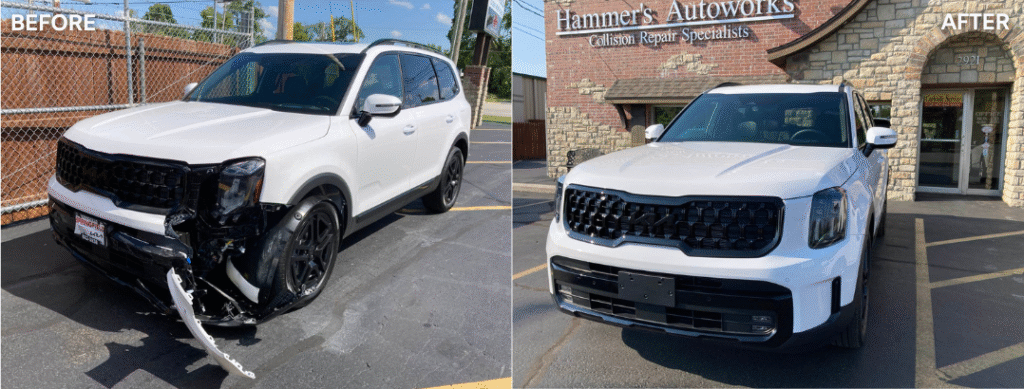
At Hammer’s Autoworks, every repair is handled by people who take the work seriously—because they understand that a car isn’t just a machine. It’s how you get your kids to school, how you get to work, how you get home safely at night. That’s not something you leave to an algorithm.
Use AI as a Starting Point—Not a Final Answer
None of this means you should swear off AI entirely. It can be genuinely useful for getting oriented after an accident, understanding your rights, and preparing for conversations with your insurer. Use it for that.
But when it comes to the actual estimate, the actual diagnosis, the actual repair—and especially the actual shop you trust with your vehicle—don’t let a chatbot make that call. AI may not be showing you the best shop in your area. It may be showing you whichever shop happened to land in the right data set. That’s not a foundation for a decision this important.
Come in. Let real professionals take a look. Ask questions. And make sure the shop you choose answers to you, not to the insurance company.
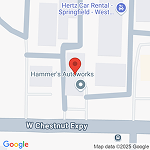
Hammer’s Autoworks is located in Springfield, Missouri. We work with all insurance companies and we’re committed to making sure your vehicle is repaired correctly and safely. Stop in or give us a call—we’ll take it from there.
FAQ: AI and Your Auto Body Claim
Q: Can AI give me an accurate estimate for my auto body repair?
No. AI works from photos and general data—it cannot see beneath the surface of your vehicle. Hidden structural damage, sensor misalignment, and frame issues won’t show up in any image. An accurate estimate requires a trained technician to physically inspect your vehicle. That’s why Hammer’s Autoworks doesn’t give estimates over the phone, either—because any number without eyes on the car isn’t really an estimate.
Q: Can AI tell me if my car is safe to drive after an accident?
No. Post-collision safety requires hands-on diagnostic equipment and professional expertise. ADAS sensors, airbag systems, and frame geometry all need to be evaluated in person. Don’t rely on an AI tool—or your own visual inspection—to make that call.
Q: Is it a good idea to let AI recommend a body shop?
We’d encourage real caution here. AI pulls from incomplete data sources, and the shops that surface in AI recommendations aren’t necessarily the best or most reviewed—they’re simply the ones that appeared in whatever data the AI was trained on or currently has access to. A shop with fewer reviews on a smaller platform may show up ahead of a shop with hundreds of verified Google and Facebook reviews. Don’t outsource this decision. Do your own research, check review volume and recency, and choose a shop with a real track record in your community.
Q: What is AI actually useful for when dealing with a claim?
AI can be a helpful starting point. It’s useful for building a documentation checklist after an accident, understanding insurance terminology, and generating questions to ask your insurer or repair shop. Think of it as a research assistant—not a claims adjuster, a diagnostician, or a shop directory.
Q: Why doesn’t Hammer’s Autoworks give estimates over the phone?
Because an honest estimate requires seeing the vehicle. Damage that looks minor on the outside can involve significant structural issues underneath. A phone estimate would only set inaccurate expectations—and that doesn’t serve you. Stop in and let us take a look.
Q: Will Hammer’s Autoworks work with my insurance company?
Yes. We work with all insurance companies and can help guide you through the claims process. You always have the right to choose your own repair shop—regardless of what your insurer recommends.
Q: What’s the difference between a DRP shop and an independent shop like Hammer’s Autoworks?
A Direct Repair Program (DRP) shop has a contract with your insurance company, which can create pressure to prioritize cost over quality. Hammer’s Autoworks is independent, which means our loyalty is to you and to the integrity of the repair—not to an insurer’s bottom line.
Q: Does Hammer’s Autoworks use OEM parts?
That’s a great question to ask any shop before you commit. OEM (Original Equipment Manufacturer) parts are made specifically for your vehicle and matter for fit, safety, and long-term performance. Ask us about parts during your visit—we’re happy to walk you through what’s being used in your repair and why.